Chess
Rewiring my brain

I play chess every day. I’ve written about this (and will continue to share this essay until the whole world has read it, you can’t stop me). Twice a day, when I can, once in the morning before I start working, to wake up the brain cells, and at the end of the day when I’m winding down, as a way to clear my head. I’ve been playing consistently since the end of December 2023, and I’m still not very good. I don’t have the kind of time needed to become very good. I’m OK. And I’m becoming OK with the fact I won’t ever be very good.
Sometimes when I tell people I have this daily chess habit they remark that they’d either like to play chess or couldn’t, and for the same reason: that it requires you to think so many moves ahead. It’s either appealing for its practical application to life away from the board or too stressful to consider. You don’t have to, if you’re just playing to play—you can just move pieces around, and actually play chess, without consideration for its norms or best practices and whatnot. But it’s true, in order to get good, you have to calculate (even if you’re boasting like José Raúl Capablanca, world chess champion from 1921-27, who said, “I see only one move ahead, but it's always the correct one,” you only get to know the correct move by knowing what follows). The number of possibilities can overwhelming—when the game starts, and no one has moved a piece, there are 1,00,000,000,000,000,000,000,000,000,000,000,000,000,000,000,000,000,000,000,000,000,000,000,000,000,000,000,000,000,000,000,000,000,000,000,000,000,000,000,000 unique games that could be played. I put all of the zeroes for effect.
But calculating isn’t simply knowing the best moves, a chess engine can find those and you can study them and replicate them and voilà. That’s no fun, and it robs you of the opportunity become attuned to things chess can teach. Calculation is better understand as the development of strategy, and in developing that strategy you can see more of your personality—you can understand more of what you want and how you want to achieve it.
I started out playing King’s pawn openings (when you have the first move as white, advancing the pawn directly in front of the King, usually the maximum allowed two spaces) because they have a reputation for exciting, attacking games. They’re less about gaining positional advantage than they are about executing tactics. You’re not so concerned about the long term prospects of a random pawn than you are with coordinating the Queen and Knight, or Bishop and Rook, or any other possible combination, toward a checkmate attack.
That’s how I’ve tended to approach this life—little-to-no consideration of structure, not examining the whole, making the move that feels like it promises immediate victory. It isn’t an invalid strategy, it just has its limitations, particularly when you account for the other thing chess requires you to learn: your calculations are your own, but you are playing against an opponent whose moves you can’t always predict. For any of your moves to mean what you want them to, the opponent has to do what you want them to. It rarely works out that way. You have to learn to make moves with as close to full consideration of what the other person might do as possible, to try to get inside someone else’s head.
If I’m starting to sound a little self-help-y, like I’m using this chess metaphor as a way to discuss self-improvement, I wouldn’t dispute the characterization. It’s the season of life I’m in. I’m trying—in the wake of unemployment, as a father faced with the challenge of toddlerhood, as a writer who has a book to write, as a partner who hasn’t always been a great communicator, as a friend who loses touch when the pressures of the world mount, as a person self aware enough to know I haven’t fully unpacked are the varying traumas lurking around inside of me—to become better.
And so, a few months ago, I switched to Queen’s pawn openings. I plateaued with the King’s pawn (I was favoring the Ponziani), and decided it was time to switch things up and go with the more positional offerings that a Queen’s pawn provides (you can move different pawns, or even Knight in the opening, and there are plenty of valid openings that do such, but the norm is King or Queen’s pawn). They’re less volatile, generally speaking, not so much about moving a few pieces into an attack as they are about optimizing each piece’s placement, until you’ve either induced your opponent into a position where they have few options for development or you yourself have created opportunities to strike. They can be slower, more deliberate. Stable. I like the Stonewall.
I’ve been moderately successful with this new approach, though there’s always the curveball—you truly never know how your opponent will respond. The thing that’s been most difficult to rewire my brain toward understanding is sacrifices. I’m risk averse; I don’t have any interest in gambits really, where you make an early sacrifice that’s supposed to provide some advantage. When under threat of losing a piece with no compensation, I typically retreat, and in the case where I don’t see it coming and lose a piece I wasn’t prepared to trade, I usually resign. I don’t want to play down material.
But there are times where a material sacrifice isn’t all bad, can indeed be winning. Look at this game I played recently:
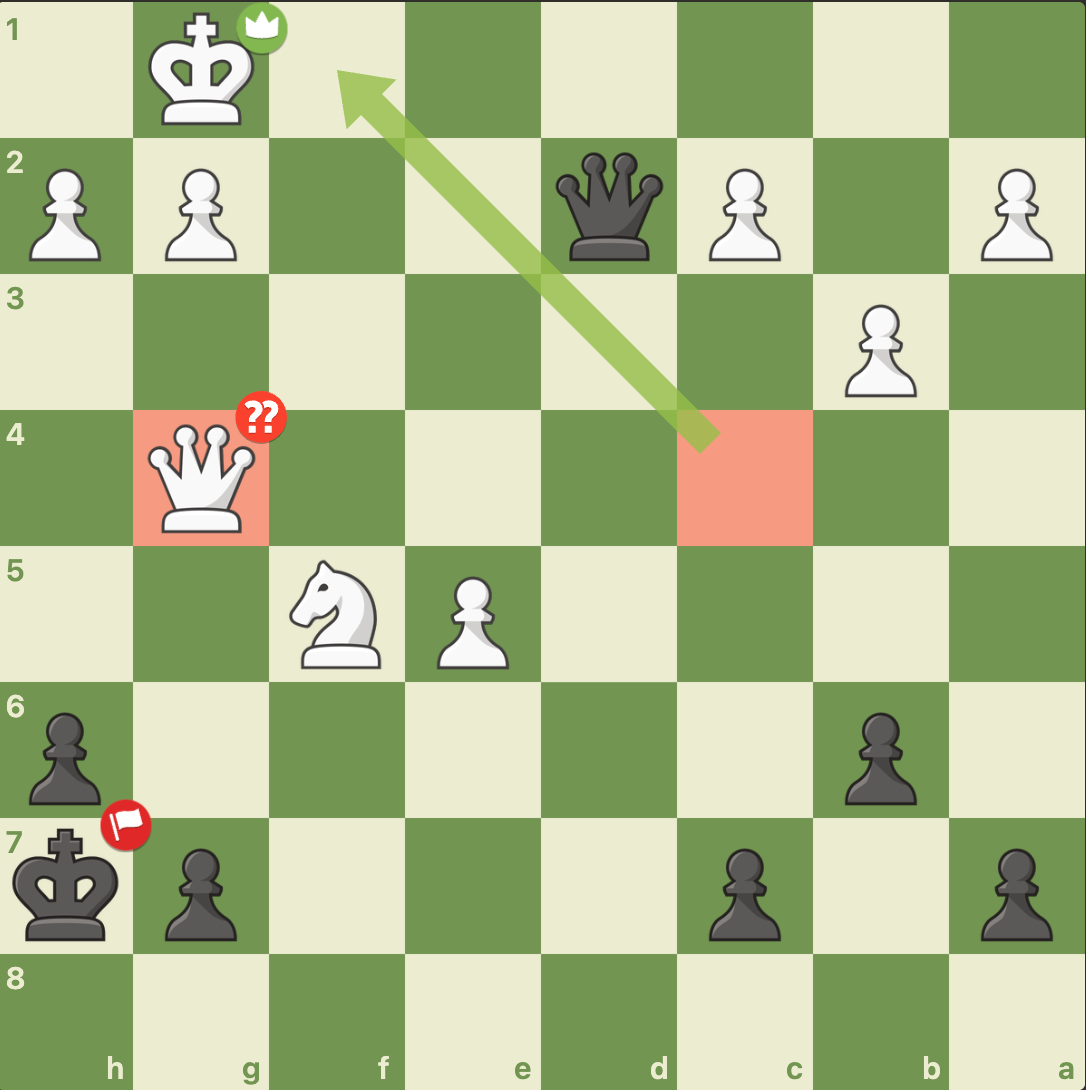
The space where you see the white Queen is where I had on the previous move put my Knight. It was a simple checkmate threat—with my Queen in position, I could move it to f2 square, with the Knight supporting on g4, and the King has nowhere to go. Only I didn’t see that the white Queen was in position to take my Knight, which is an oversight I’m prone to making. Only it wasn’t a mistake, as you can see by Chess.com’s engine showing a the white Queen with the red bubble and question marks, indicating a blunder on their part. In taking my Knight, they left the King undefended from a checkmate from my Queen, if I moved to e1.
Only I resigned right after they took the Knight. I was so distraught over the material loss, I quit a winning position, snatching defeat from the jaws of victory. When I reviewed the game, I literally kicked myself. I deserved it.
Had I taken a little more time to examine the board before resigning, I probably would have seen the win. But that’s not how my brain works. I have a hard time see any kind of setback as an opportunity, to find a new strategy in the face of material disadvantage.
Most of the time. I’m not very good at chess yet, but I have gotten better, and that includes becoming better at seeing what is a good sacrifice to make. I don’t always make them, still to risk averse, but every now and then I see it and, with deep reservation and a trembling spirit, I go for it. Like this game from a few weeks ago:
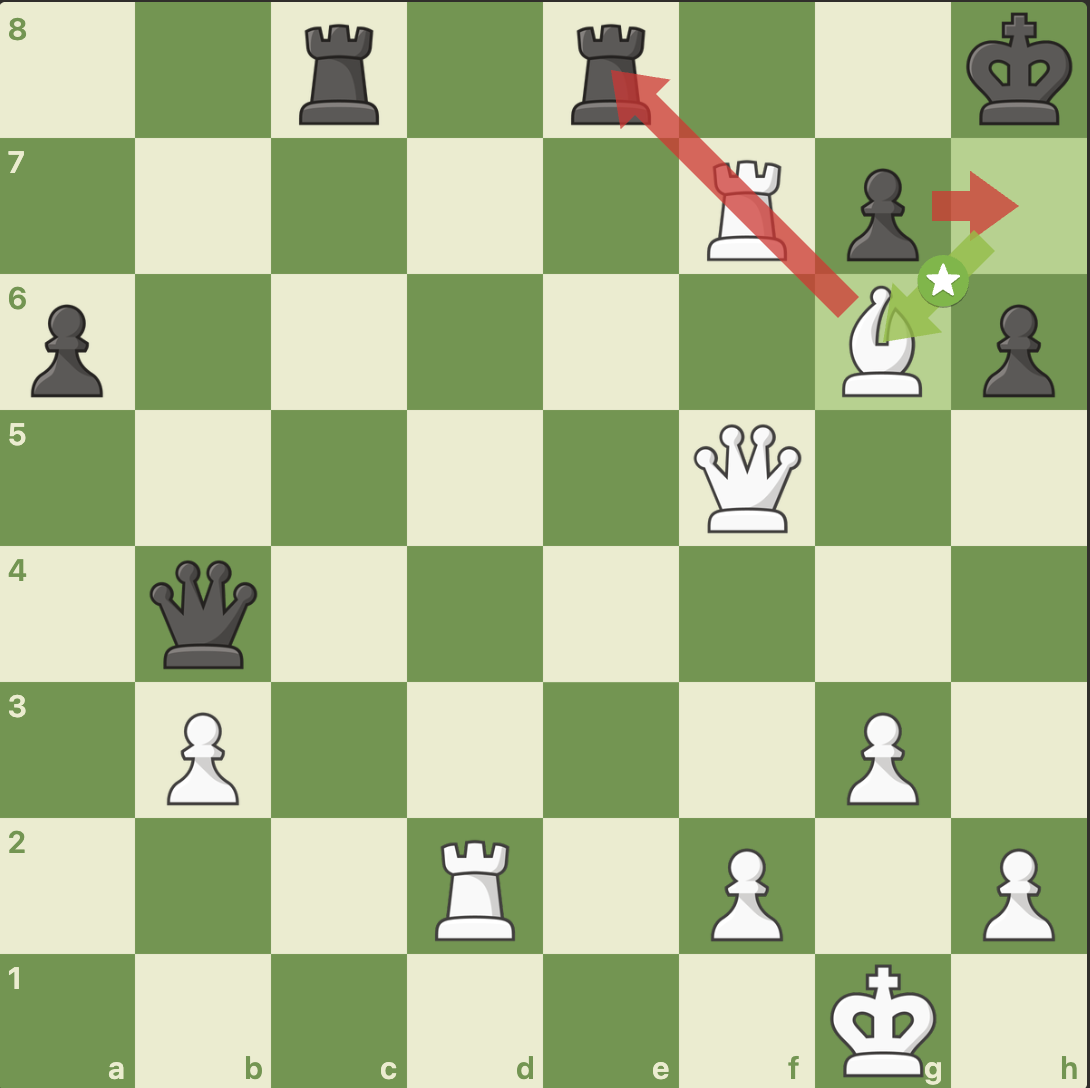
It looks like I’ve left my Rook on d2 abandoned to capture, and I have. Because right here I’m setting up checkmate attack my opponent can’t do much about. Once they take the Rook, which they did, I can move my Rook on f7, currently defended by the Queen, and take their pawn on g7, as I did:
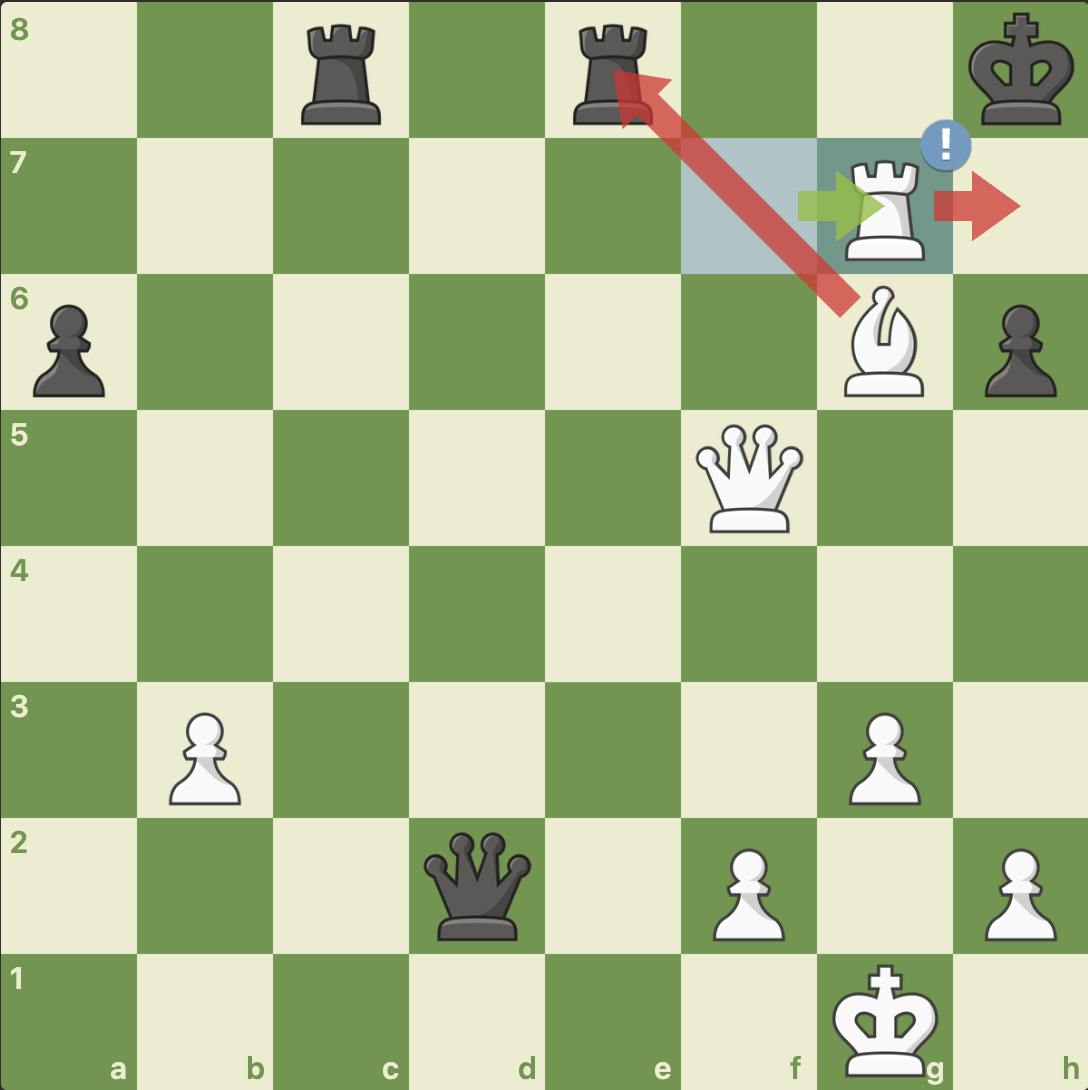
And now they have tough choice to make: if they take the undefended Rook with their King, my Queen comes up to f7, delivering check and defended by the Bishop on g6, forcing their King back to h8, then my Queen to h7 with checkmate. They don’t have to do that, they can check my King with their Queen, but I just move out the way and they have no more forcing moves to make, and if they leave my Rook on the board then I check on h7, their King moves to g7 with its only move, then my Queen delivers checkmate on f7. Instead of any of that, they resigned.
Which is all to say: I’m learning. Learning to play positional, learning to look deeper into the future, learning to be comfortable with some loss, learning to readjust strategy. Little by little. I’m learning.
Reread “Scholar’s Mate” and I’m yet again crying. My favorite lines remain: “I’m glad to be able to think again, in the way I’ve grown accustomed to, but now that ability comes with the awareness that attempting to use it to counteract the effects of grief is a losing position. I can’t afford my usual stubbornness here. I have to process. I have to feel. I have to believe this is not in conflict with some other version of myself, but part of a whole being.” Read this post and I’m now contemplating a revival of my childhood chess hobby. You mention there are a very large number (that I’m not going to paste here) of unique chess games possible, and this week you prove there are at least two unique chess metaphors for life worth reading.